Art Trends That Give Rooms Lasting Presence

A room can have custom millwork, beautiful stone, and furniture chosen with care, yet still feel unfinished. Often, what is missing is not another decorative object. It is a point of view. The most meaningful art trends moving into 2026 are less concerned with filling wall space and more concerned with giving a home a distinct emotional center.
For homeowners, designers, and collectors, that shift is useful. It moves the conversation away from matching art to a pillow or buying a generic oversized print simply because a wall is large. The strongest choices now bring atmosphere, a sense of place, and enough visual depth to reward attention over time.
Art Trends Favor Work With a Sense of Place
A growing preference for place-driven art reflects a broader desire for interiors that feel personal rather than staged. A quiet shoreline, a weathered industrial corridor, a city scene at dusk, or a stand of trees shaped by changing light can carry a lived-in feeling that trend-based decor cannot manufacture.
This does not mean every piece must depict a location the owner knows. The connection can be emotional. A collector may respond to the stillness of a Midwestern horizon, the graphic energy of an urban facade, or the calm geometry of water and sky. The work becomes meaningful because it changes the mood of the room and gives guests something to notice beyond the furnishings.
For a primary residence, place-driven artwork is especially effective in entryways, living rooms, and dining spaces where a home makes its first and strongest impression. In a commercial setting, it can establish a local connection without resorting to literal branding. The best work suggests a story while leaving room for the viewer's own.
Texture Is Returning, Even on Clean Walls
Minimal interiors are not disappearing, but starkness is giving way to warmth. Plaster finishes, natural woods, linen upholstery, stone, and hand-finished metals are appearing beside cleaner architectural lines. Art that has tonal range, visible detail, and a strong material presence belongs naturally in these spaces.
This is one reason finely produced landscape and urban imagery continues to resonate. It can introduce complexity without creating clutter. Mist over water, layered clouds, aged brick, reflections in glass, or the precise lines of a bridge all add texture through observation rather than ornament.
The key is restraint. A heavily detailed work can be compelling in a room with simple furnishings and generous negative space. In a richly layered room, an image with a quieter palette and clearer composition may provide a needed pause. Texture should deepen the room, not compete with every finish already in it.
Consider the Viewing Distance
Texture changes according to scale and placement. A large work seen from across a living room needs a composition that reads immediately. As someone approaches it, secondary details should emerge: subtle shifts of color, small architectural elements, delicate branches, or light moving across a surface.
In a hallway or breakfast nook, viewers stand closer. Here, intimate pieces can succeed because the experience is more direct. This is not simply a question of filling a measured area of wall. It is a question of how the work will be encountered every day.
Large-Scale Art Is Becoming More Intentional
Oversized art remains one of the most requested solutions for expansive walls, particularly in new construction and renovated open-plan homes. But scale alone is no longer enough. A large piece needs compositional discipline. If the image feels empty, repetitive, or overly literal, increasing its size only makes the weakness more apparent.
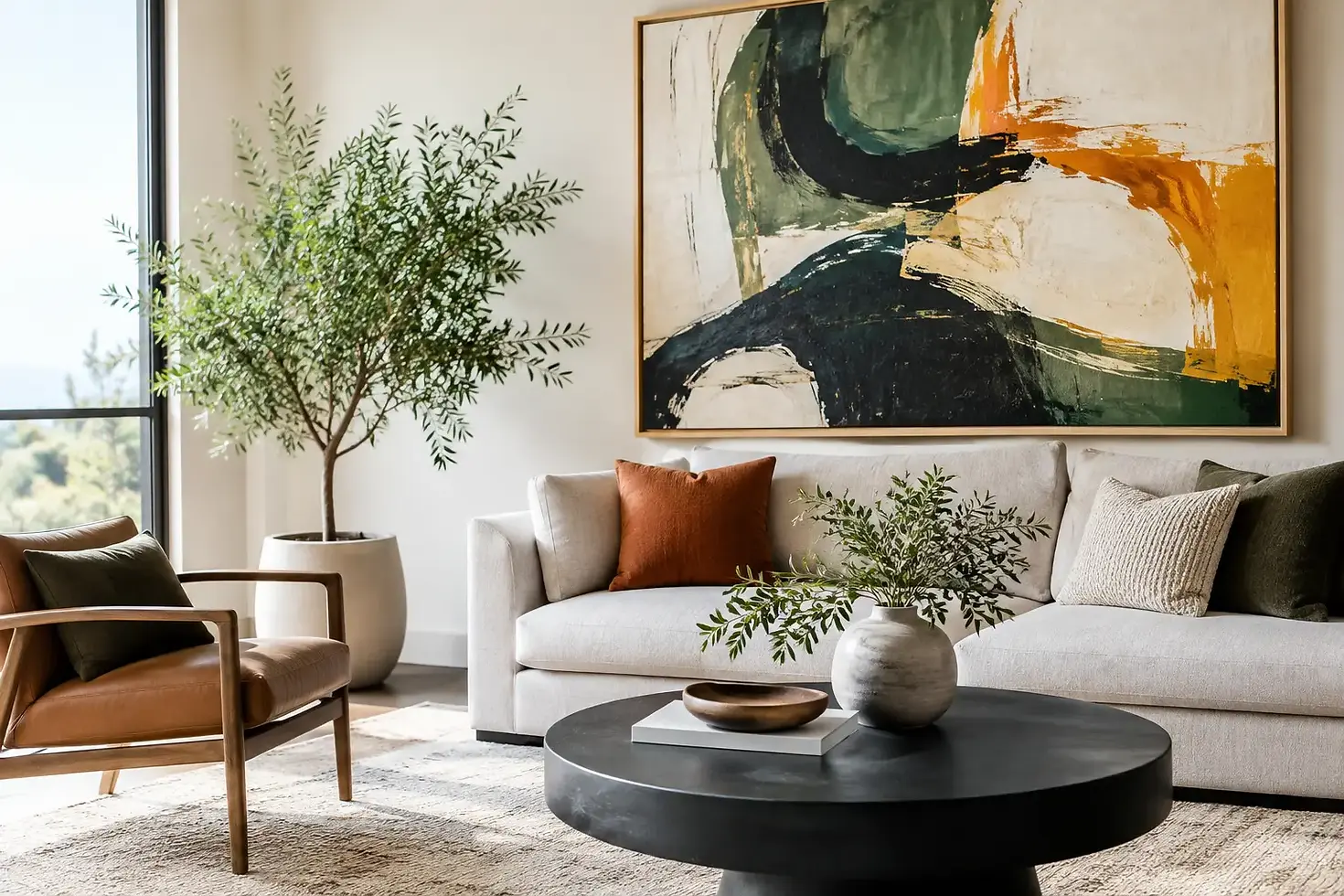
A considered large-format work can anchor a room more effectively than a gallery wall assembled from unrelated pieces. It creates a visual destination and gives furniture arrangements a clear center. Above a long console, behind a dining table, or across from a fireplace, one substantial work can establish order without making the room feel formal.
There are trade-offs. Large art demands careful attention to sightlines, ceiling height, wall color, and lighting. It also deserves breathing room. A work that nearly touches adjacent furniture, sconces, or door frames can feel like an afterthought. Before selecting a final size, mark the proposed dimensions on the wall with painter's tape and view it from the room's main approaches.
Color Is Moving Beyond Exact Matching
For years, art was often chosen as a final color-matching exercise: find the blue that repeats the rug, the gold that echoes the hardware, or the neutral that disappears into the wall. Current interiors are more confident when art leads rather than follows the palette.
That does not require a dramatic contrast in every room. It means choosing a work for its overall temperature, tonal character, and emotional effect. A blue-gray river scene can cool a sun-filled space. An image with amber light can bring welcome warmth to stone and charcoal finishes. Deep shadows can give a pale room definition.
Designers often speak of repetition because it creates cohesion. That principle still matters, but repetition can happen through mood as much as color. A work with soft silver light may relate beautifully to brushed nickel, pale oak, and natural linen even if it contains none of those exact shades.
Let the Artwork Introduce One New Note
A useful approach is to allow a major piece to introduce one color or tonal quality that appears only lightly elsewhere. Perhaps it is a muted rust against cool neutrals, a nearly black horizon in an airy room, or a soft green that brings the exterior landscape indoors.
That new note gives the room dimension. It prevents the carefully selected finishes from becoming too predictable and makes the art feel integrated without making it merely decorative.
Collected Rooms Need a Clear Visual Thread
The move away from showroom-perfect interiors has encouraged collectors to combine older pieces, contemporary furniture, travel objects, and art acquired over time. The result can feel deeply individual. It can also become visually noisy when every wall tells a different story at the same volume.
A clear visual thread helps. It may be a consistent use of black, white, and natural wood framing. It may be a recurring relationship to landscape, city structure, water, or seasonal light. It may be a shared tonal range across several pieces. The point is not to make everything match. It is to create enough continuity that the collection feels considered.
When combining multiple works, give each one a reason to be there. A stairway can hold a sequence that rewards movement from one floor to another. A study can support smaller, more contemplative work. A living room usually benefits from one primary statement and a few supporting elements rather than several competing focal points.
Physical and Digital Collecting Are Serving Different Needs
Digital art collecting remains part of the contemporary art conversation, particularly for collectors who value provenance, limited editions, and display flexibility. It can be an engaging extension of a collection, but it should be chosen for the quality of the work rather than the novelty of the format.
Physical art, however, continues to offer something distinct in the home: scale, surface, permanence, and an interaction with changing natural and interior light. A work on the wall becomes part of daily life. It is present during quiet mornings, dinners with friends, and the ordinary moments that make a house feel inhabited.
There is no need to treat physical and digital collecting as opposites. They can complement one another when both are guided by the same standard: choose work with a point of view, clear authorship, and lasting visual interest.
The Best Art Trends Are Not a Shopping List
Trends are most useful when they clarify what you already value. If a room needs calm, seek a work with space, atmosphere, and measured color. If it needs energy, consider a city scene, dramatic weather, or a composition with strong directional movement. If the architecture is already expressive, choose art that supports it rather than trying to outshout it.
Investment-worthy art should not feel like a seasonal accessory. It should make the room feel more like yours each time you enter. Start with the wall that matters most, consider the light and the life that happens around it, and choose the piece you will still want to meet with your eyes years from now.


Comments